
Deep Omics Data Analysis
Bioinformatics analysis and visualization for single-cell multi-omics data
Data Analysis Service
Single-cell multi-omics technologies generate data characterized by high dimensionality, sparsity, and complexity. From raw sequencing data to interpretable biological discoveries, data analysis is the critical step that transforms data into insight.
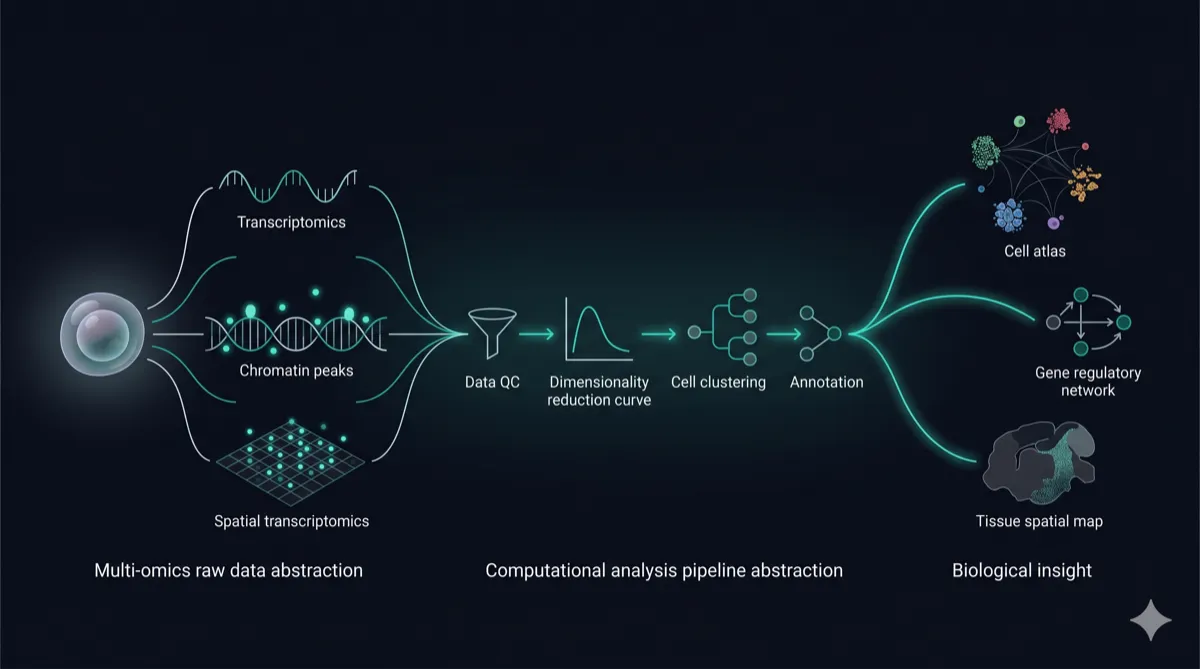
We provide deep data analysis services covering single-cell transcriptomics, epigenomics, spatial transcriptomics, immune repertoire, and Perturb-seq. Our analysis pipelines adopt reproducible computational environments and widely validated tool ecosystems, centered on the core logic of 'quality control — quantification — dimensionality reduction — annotation — functional interpretation', ensuring reliability and traceability of results.
Service Details
Single-Cell Transcriptomics Analysis
- Data Preprocessing Demultiplexing, alignment, quantification, and quality control of raw sequencing data to generate gene expression matrices
- Dimensionality Reduction & Clustering Cell population partitioning and visualization based on PCA, UMAP, and other algorithms
- Differential Expression Analysis Identification and statistical testing of differentially expressed genes across cell groups
- Cell Type Annotation Cell identity assignment based on known marker genes and reference datasets
- Functional Enrichment Analysis Pathway enrichment across multiple databases including GO, KEGG, Reactome, and MSigDB
- Trajectory Inference Pseudotime analysis to reconstruct cell differentiation pathways and transcriptional dynamics
- Cell-Cell Communication Analysis Construction and quantitative evaluation of ligand-receptor interaction networks
- Gene Set Scoring Pathway activity assessment using AUCell, AddModuleScore, and other methods
Single-Cell Epigenomics Analysis
- scATAC-seq data preprocessing and peak calling
- Chromatin accessibility profiling and motif enrichment analysis
- Joint analysis of single-cell multi-omics data (transcriptome + epigenome)
Spatial Omics Data Analysis
- Expression mapping and visualization of spatial transcriptomics data
- Spatial domain segmentation and tissue microenvironment characterization
- Spatially variable gene identification
- Spatial-single-cell data integration and mapping
Immune Repertoire Analysis
- Single-cell TCR/BCR repertoire assembly and clonotype identification
- Immune cell clonality assessment and diversity analysis
- Antigen-specific enriched clonotype tracking
Perturb-seq Data Analysis
- sgRNA detection, quantification, and gene assignment
- Single perturbation vs. co-perturbation distinction and filtering
- Perturbation efficiency evaluation and effective perturbation cell selection
- Gene perturbation–transcriptomic phenotype association analysis
- Genetic interaction inference for multiplex perturbations
- Gene functional clustering and pathway mapping based on perturbation effects
Multi-Omics Data Integration Analysis
- Cross-batch data correction and integration (Harmony, Seurat RPCA, scVI, etc.)
- Multi-omics molecular subtype discovery
- Gene regulatory network inference
- Genotype-phenotype association analysis
- Predictive model construction using machine learning methods
Delivery Standards
- Data Delivery Structured data tables including expression matrices, clustering results, differential analysis results, enrichment analysis results, etc.
- Visualization Delivery Standard figures including UMAP/t-SNE clustering plots, heatmaps, violin plots, bubble plots, feature plots, pseudotime trajectory plots, etc.
- Analysis Report Method parameters and environment configuration documentation, result interpretation guidelines
- Specialized Support Discussion of analysis results in the context of research objectives and recommendations for next steps
Analysis Pipeline
Project Collaboration Process
- Requirement Discussion Evaluate research objectives and sample characteristics, confirm analysis plan and technical route
- Plan Confirmation Define analysis scope, deliverables list, and milestones
- Data Analysis Execute analysis following standardized pipeline, provide periodic feedback on key results
- Delivery & Interpretation Deliver complete datasets and analysis reports, provide result interpretation assistance
Customized analysis plans available upon request.